
Ten Reasons for Realistic Hope, Part Three
Things Can Get Better—And Soon
This piece originally appeared on Fran Quigley’s blog Housing Is A Human Right on April 17, 2026.
In the midst of global violence, record homelessness, and widespread poverty, it is worthwhile to consider all the reasons that the dire situation in the U.S. and across the world can get better. We are working towards a brighter future, so we need realistic hope that it is possible.
Last week, and the previous week, we shared the first five reasons for realistic hope:
1. The bilions spent on the Iran war show that we already possess the funds to ensure housing, healthcare, and other basic necessities for all;
2. A new push to ensure a subsistence income for our most vulnerable neighbors living with disabilities;
3. The people of Minnesota’s inspiring grassroots resistance to Trump’s violent siege on their city;
4. Unions are growing larger and stronger; and
5. Tech can help tenants, too.
This week, Reasons Six and Seven:
6. Progress in Taxing the Rich
Our first reason for realistic hope was that the billions spent on the Iran war prove that money is available for the far better uses of housing and healthcare for all. Relatedly, as economists like Mark Paul have long insisted, we can fully fund universal social programs if we fairly tax wealthy individuals and corporations. The U.S. has done this in other eras, including the 1950’s, where the top marginal tax rate was 91%. As Bernie Sanders has said, “I’m not much of a socialist compared to Eisenhower.”
So it is heartening to see progress in this important mission to tax the rich. (By the way, Tax the Rich! is the title of a book my wonderful son Sam helped write, which describes the many loopholes exploited by the ultra-wealthy.) California’s proposed Billionaire Tax would target the 200 people in the state who are worth more than $1 billion, and raise funds that would be directed to healthcare, public K-14 education, and state food assistance programs.
The Billionaire Tax is on California’s ballot this November. It has the endorsement of Sen. Sanders, unions like Service Employers Union International (SEIU) and Teamsters California, Rep. Ro Khanna, and even billionaire Tom Steyer. Polls show a majority of Californians are in support.
The rest of the country likes this idea, too. National polling shows a strong majority of voters support increasing taxes on wealthy corporations and individuals. The Roosevelt Institute has a new proposal to tax the ultra-rich at the federal level.
Wealth inequality is at its highest level in decades. Not coincidentally, so are poverty indicators like record homelessness. Fairly taxing the ultra-wealthy is the path to fixing this, and the American people are demanding it.
7. Momentum for Raising the Minimum Wage to a Living Wage
The U.S. minimum wage is a shameful $7.25 per hour, a fraction of what it cost for even small families to make ends meet. Many states, including my home state of Indiana, have kept our minimum wage that low as well.
That leads to our eviction court clients, who work hard at jobs like home healthcare, food service, and security, falling behind on rent and often becoming homeless,
We should never see someone who wears a healthcare worker’s scrubs or a fast-food uniform in eviction court, much less sleeping in their car. I recently spoke with a man who is sleeping on the street, then waking up for an early bus to get to his restaurant dishwasher job. Working and homeless is a very real phenomenon in the U.S.
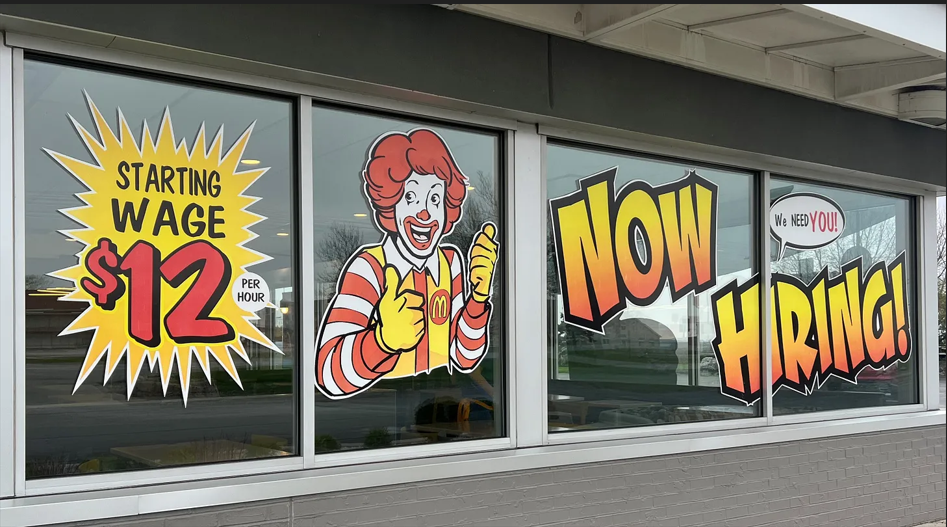
Photo taken by author in northern Indiana earlier this month. The living wage for even a single person in Indiana is nearly $22 per hour, and much higher if the worker has a child.
A new column in Time magazine by Arindrajit Dube, Provost Professor of Economics at the University of Massachusetts Amherst is entitled “America’s Cost-of-Living Crisis Is Really a Pay Crisis.” Prof. Dube explains that it is not enough to talk about “affordability” in general or high gas prices and rising rents specifically:
All these matter. But we’re missing half the equation. If we’re serious about making life affordable for working families, we also need to talk about the other side of the ledger: paychecks. And here’s the truth: over the past 45 years, wage growth for most Americans has been halting at best, often failing to keep up with the country’s overall economic gains . . .
Prof. Dube helpfully summarizes the evidence showing increasing minimum wages is politically popular and avoids negative economic impacts:
When minimum wage increases have appeared on state ballots, they have won nearly every time, in red, blue, and purple states alike. And in states that have raised their floors, workers have seen pay rise without the job losses often predicted by critics. Instead, companies see turnover fall and productivity rise as these jobs are made better. A combination of small price increases and somewhat lower profits helps businesses adjust to the higher pay.
The good news is that 34 state and district governments have raised their minimum wages above the federal level. As Prof. Dube referenced, even voters in red states approved minimum wage increases in 2024.
That momentum continues. Virginia has recently committed to raising its minimum wage to $15 per hour by 2028. Legislation to substantially increase the federal minimum wage has been filed in Congress, and hopefully will move forward after the next elections.
“Working and homeless” should be an oxymoron. Making minimum wage equate to a living wage is an important step in that direction.
Next week: Reasons Eight, Nine, and Ten to hold realistic hope!
