
Our Focus
GIMA organizes the faith community of Indianapolis to advocate for fair, affordable housing and ending Indy’s eviction crisis.
Affordable housing, homelessness, and evictions

Why Housing and Evictions in Indiana
What’s the current landscape?
Housing instability, particularly evictions, is receiving its due attention in this critical moment because it’s nearing a full-blown crisis. According to Eviction Lab, Indianapolis is second only to New York in total evictions and Indiana is number one in statewide eviction filings since 2020. We recognize that there are several excellent non-profit organizations that provide direct services, as well as coalitions that amplify the voices and needs of those grappling with the impact of evictions and homelessness through advocacy. We also know that many congregations periodically collect food and clothing – and even temporarily house the homeless.
The Data
Indianapolis ranks #2 in the entire country in evictions, behind New York City
Marion County averages 400-600 weekly eviction filings since March, 2020
65% of eviction filings are from large multi-family developments, though only 14% of renters live in these properties.
Those properties with high eviction rates also tend to be at the higher end of the Marion County Public Health violations list.
The eviction crisis is not just an Indianapolis problem. See chart on back of this page for county-by-county data.
Indiana is one of five states that does not allow a tenant to escrow rent for repairs. Escrow programs can reduce eviction rates for tenants while creating an equitable process that does not hurt responsible landlords or affect their ability to pay their mortgage and other costs.
Housing costs for Hoosiers continue to skyrocket
Marion County has seen rent increase an average of 20% ($200-$300/month) since 2020, while wages have only increased by 4%. This level of increase is simply unsustainable.
Despite record rent increases, apartments in Indianapolis hover around 96% occupancy, meaning that renters are stretching their budgets to keep a roof over their heads.
While development of multifamily units is up, newly constructed units are not meeting affordability needs. Average asking rent is up to 30%, roughly $300 a month.
In 2020 50% of renters were cost-burdened, paying more than 30% of their income in rent.
Nearly 25% of renters were severely cost-burdened, paying more than 50% of their income in rent.
Out-of-state investors (institutional investors) contribute to Indiana’s housing crisis
Out-of-state investors seek out Indiana for its landlord friendly laws, not only hurting renters but homeowners as well.
60% of rental property owners in Indiana reside in Illinois, California, Georgia, Texas, and Florida.
26% of residential property purchases in Indiana were by investors at the end of 2021. Indiana is on track for more than 30% of all residential property purchases to be by investors.
Indianapolis is #1 of U.S. cities for out-of-state corporate investment in real-estate. Whereas most cities average 3%, Indianapolis is at 15% and growing.
Indiana Lacks in Affordable Housing Options
Half of renters in Marion County earn less than $35,000 but only 35% of multifamily units meet the affordability thresholds.
Prosperity Indiana & NLIHC report that Indiana has a gap of 135,033 affordable and available rental units for the bottom 30% of area median income (extremely low income households).
Affordable housing is scarce outside of Marion County. 80% of the 63,000 affordable units are in Marion County, leaving renters around Indiana with few affordable housing options.
The Indiana Behavioral Health Commission cited housing instability as a primary contributor to mental illness issues. As Indiana tackles our mental health crisis, we must also consider affordable housing as part of the solution.
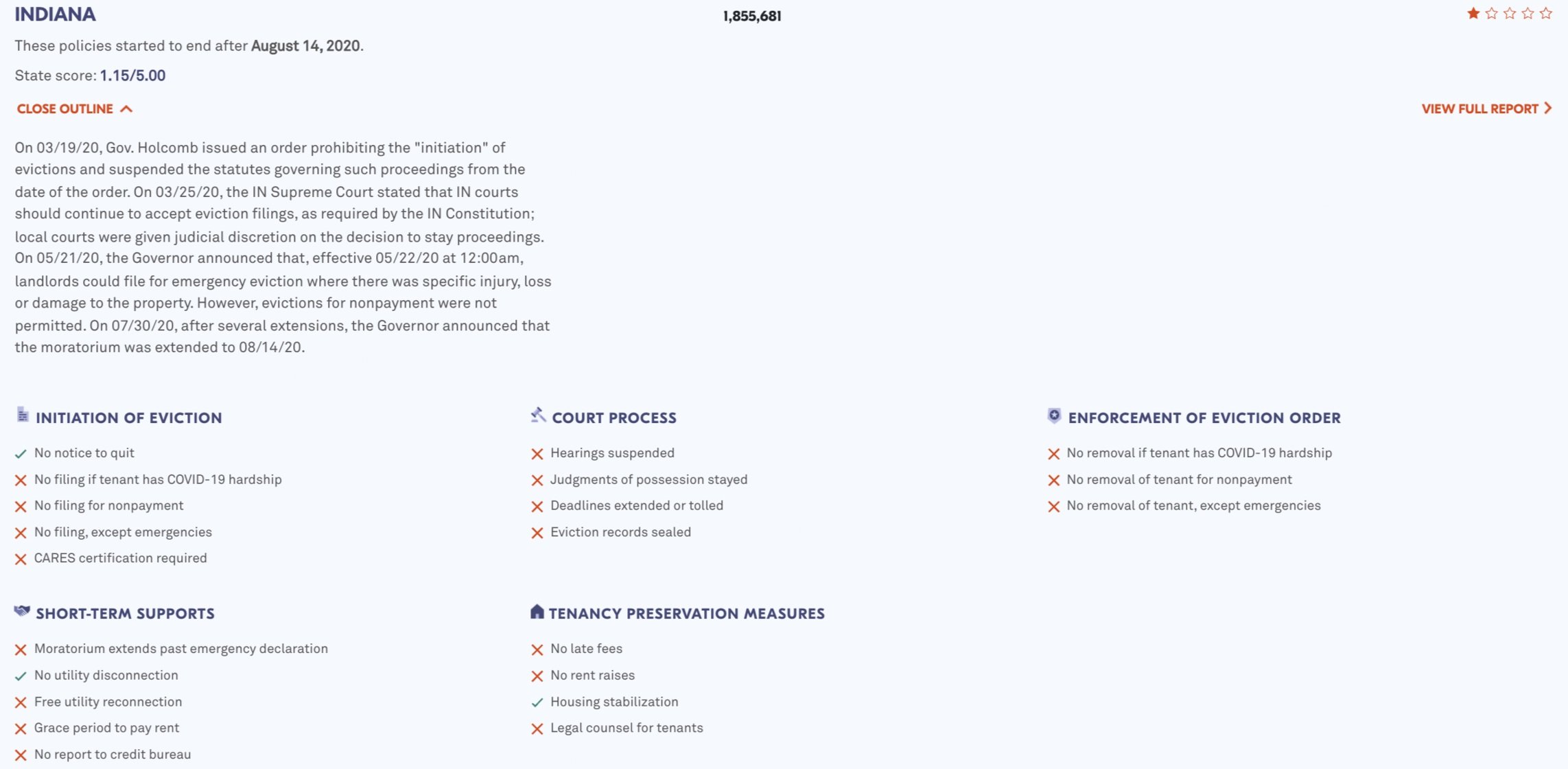
Eviction Lab Policies Scorecard for Indiana
Indiana Scored 1.15/5.00
Your Rights as a Renter in Indiana
Renters’ rights typically fall under the jurisdiction of state or local government. The tenants’ rights below apply to all renters in the State of Indiana. However, some communities may have additional regulations for tenants and landlords.
Source: Adapted from Warranty of Habitability, Indiana Legal Services.
As with all information contained on this website, you should not consider this legal advice and you should seek advice from a lawyer.
-
Typically, leases have an “implied warranty of habitability.” What does this mean?
“Habitable” means a safe and clean place to live, in compliance with local housing codes.
Keeping the rental premises habitable also means that landlords must follow state health and fire codes and maintain common areas.
The rental unit must be clean, with toilets, furnaces and windows working.
Locks must be on every outside door or doors that lead to a common area.
Keeping rental premises habitable includes maintaining the structural safety of the building and weatherproofing.
“Implied” means the landlord must keep a rental home safe to live in—even if this is not stated in a lease agreement.
-
The landlord must provide you with a rental unit in a safe, clean, and livable condition. These responsibilities include:
Comply with health and housing codes.
Provide and maintain the following in good and safe working condition (if there at the time you signed your lease):
Electrical systems
Plumbing, including a reasonable supply of hot and cold water at all times,
Sanitary systems
Heating, ventilating, and air conditioning (including an adequate supply of heat at all times)
Elevators (if applicable)
Appliances supplied to encourage you to enter into the lease.
-
Landlords have a duty to maintain common areas throughout rental premises in clean and proper condition. Common areas are those areas shared by all tenants. These include fences, parking, landscaping and recreational areas.
-
Landlords must give you advance notice before they enter your dwelling. The only exception is in the case of an emergency.
-
You have the right to access your rental home at all times. It is illegal for a landlord to deny you access to your rented property by means of changing locks, barring windows or removing doors. The only way a landlord may deny you entry to your rental property is through a court order. You also have the right to continuous use of your utilities without interruption to these services.
-
You must give the landlord notice of the problem and a reasonable time to fix it. Put the date on the notice, and keep a copy for yourself. You must give the landlord access to the unit to make repairs.
If the conditions are bad, you can also contact your local board of health or code enforcement office to report the conditions in your home.
Unlike some states, Indiana does not have a law that lets tenants withhold rent or make repairs and deduct it from the rent.
Generally, if you do not pay rent, you could be evicted. There may be very limited cases where you can repair and deduct, but you should talk to a lawyer first.
-
If the landlord does not fix the problem in a reasonable time, the law says you can sue. Either a tenant or landlord can sue in court. They can get damages, orders to repair, and attorney fees. It’s always a good idea to speak with a tenant’s rights attorney to evaluate your options, especially if a landlord is:
Invading your privacy
Not keeping the premises safe and in compliance with health and housing codes
Failing to fix appliances
Failing to provide adequate heat and hot water
However, if you are in violation of the lease in any way, most landlords may choose to simply file an eviction.
-
As a tenant in the state of Indiana, you have the right to have your security deposit returned within 45 days if you leave the rental property to the landlord in good order when the lease ends and give your landlord your forwarding address in writing.
It is illegal for the landlord to use a security deposit for repairs to the property as part of normal wear and tear—such as carpet cleaning or repainting walls.
The landlord may subtract from the security deposit unpaid rent, the cost to repair damages to the rental property, or other unpaid obligations under the rental agreement.
If a landlord wants to charge you for damages to the property, he or she must also give you an itemized list of damages and the cost of repair within the same 45-day period.
-
Comply with health and housing codes that apply to tenants.
Keep the home reasonably clean.
Not deface, damage, destroy or remove any part of the home.
Follow all reasonable rules and regulations of the property.
Deliver the home back to the landlord in a clean and proper condition.
Ensure smoke detectors work and are not disabled. Replace batteries as needed.
Use these in a reasonable manner:
Electrical systems
Plumbing
Sanitary systems
Heating, ventilating, and air conditioning
Elevators (if supplied)
Facilities and appliances
-
A separate law requires landlords to provide smoke detectors and have the tenant acknowledge in writing that the unit has a functional smoke detector.
Each landlord must install a battery or hard-wired smoke detector. If a tenant gives written notice to replace or repair a smoke detector, the landlord must do it within seven (7) working days after notice.
Report violations to your local prosecutor. Ask for inspections by the state fire marshal’s office.
-
Information about the specific rights of tenants in Indiana who have been victims of domestic violence is available here.

Join Our Work
Help Us Address This Issue in Our City