Our Already Tattered U.S. Safety Net is Fraying Even More, Part One
Trump and Congressional Republicans are Making a Bad Situation Worse
This piece originally appeared on Fran Quigley’s blog Housing Is A Human Right on January 30, 2026.
“Keep looking for help. There are lots of resources out there if you just search for them.”
More times than I can count, I have heard someone confidently repeat this statement to our struggling clients. Too often, the speakers are judges who are at the same time denying health coverage for a person living with disabilities, blocking someone who has been laid off from their job from unemployment benefits, or ordering the eviction of a family from their home.
At the same time, right-wing think tanks insist our welfare system is generous. Even well-meaning social work programs claim our programs ensure people meet their basic needs.
Repeating this claim may make some of us feel better. But it is not true.
The U.S. is the richest nation in the world. It is also one that, compared to similar nations, has a significantly higher poverty rate, more people going without healthcare and medicines, more children living in hunger, and more people living without shelter.
This widespread suffering can be directly linked to our tattered safety net. The U.S. spends 18.5% of our gross domestic product on housing, healthcare, and other economic needs, an amount markedly lower than other democratic, market-based countries. Germany, for example, spends over 25% of its GDP on government-provided assistance; Japan spends 22.6%; and France nearly 31%.
The One Big Beautiful Bill Act passed last year is making things even more difficult for many struggling people in the U.S. Thanks to Jacobin for publishing my article this week about our tattered safety net. You can read it on their site here.
I will share here in three parts a description of how our existing programs come up well short of meeting those needs for the persons who qualify.
Part One below covers food needs and family support. Part Two will describe our subsistence income programs and healthcare. And Part Three will cover unemployment insurance and housing. It will also include a reminder that even our flawed safety net programs have a deeply positive impact. If these programs are fully funded and accessible to all who need them, we can end U.S. poverty.
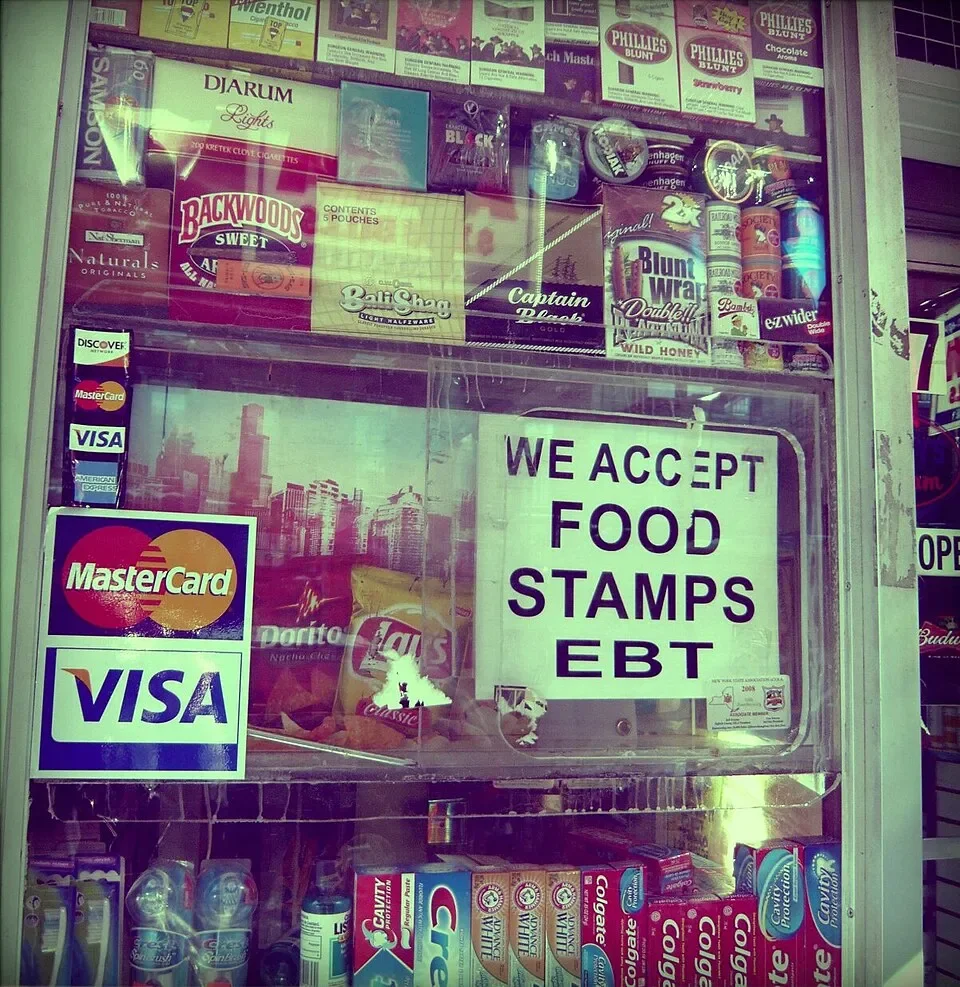
Image by Clementine Gallot via Wikimedia Commons
Food
The Supplemental Nutrition Assistance Program (SNAP), also known as Food Stamps, is far and away the largest U.S. food program, with nearly 42 million people receiving benefits. But those SNAP benefits fall well short of what is needed to keep families fed.
Analysis by the Urban Institute shows that even the maximum allotment of SNAP is significantly less than the cost of even modestly-priced meals. In urban areas, meals can cost 28% more than SNAP benefits cover. So it is no surprise that one-third of households that receive SNAP benefits also have to seek help from food pantries or emergency kitchens.
Worse yet, many who qualify for SNAP never receive it. Red-tape barriers to applying for food assistance, not to mention an intimidating process for recertifying eligibility, cause 14% of eligible children to receive no SNAP assistance at all. Three of every five eligible seniors who qualify for SNAP get no benefits.
The One Big Beautiful Bill Act further constricted SNAP enrollment, expanding work requirements to adults up to age 64, and including veterans and unhoused people. Work requirements for benefits programs may seem reasonable on their face, but they have a long track record of overreach, creating a bureaucratic barrier that kicks out people who are already working or living with disabilities. The OBBBA also disqualifies from food assistance many refugees, asylees, and survivors of domestic violence who formerly qualified for help.
Family Support
U.S. programs providing financial assistance for impoverished families have long been shaped by two forces. The first is condemnation of single parents, particularly Black mothers. The second is business elite’s determination that working-age family members are desperate enough to seek and accept poverty-wage jobs. Those ugly motivations endure, in part through the appallingly low levels of benefits provided.
The program once known as Aid to Families with Dependent Children (AFDC), renamed in 1996 Temporary Assistance to Needy Families (TANF), provides cash benefits that vary across the states. But one uniform characteristic is that the assistance provided is far lower than the amount a family needs to survive.
Maximum TANF benefits are less than 60% of the federal poverty level in every state, and below 20% of the federal poverty level in more than a third of states. In my home state of Indiana, for example, the maximum monthly TANF benefit for a family of three is just $513, which covers only a fraction of typical rent, not to mention other expenses.
As with SNAP, even this paltry sum is denied to millions of families in need. The “Temporary” in TANF’s title is no joke: the Personal Responsibility and Work Opportunity Reconciliation Act (itself an Orwellian name) was passed by the Newt Gingrich Congress in 1996 and signed into law by President Bill Clinton.
The punishing foundation of TANF, which triggered the resignation in protest by two high-ranking Clinton welfare policy officials, created a nationwide family lifetime time limit for benefits of 60 months. States are free to impose even more restrictive limits: in Indiana, the maximum is just 24 months.
Before the 1996 roll-back, nearly 70% of families with children in poverty received AFDC assistance. Now, these time limits, paired with work requirements and other red-tape barriers like recertification obligations, have limited TANF to just 21% of those families.
Next Post: Part Two, Subsistence Income and Healthcare

