
Can Your Community Follow the Lead of a Georgia Program?
This piece originally appeared on Fran Quigley’s blog Housing Is A Human Right on January 23, 2026.
On a recent afternoon in eviction court, we met Melissa (not her real name). Her path to this court hearing began when her car’s alternator went out the month before. Melissa needs that car to get to her food-service job and to bring her two young kids to childcare. Paying for the repair was a must.
But the cost left Melissa without rent money, not to mention the late fees and court fees that were tacked on once she was late.
By the time her court date came around, Melissa had resigned herself to the fact that she could not catch up on that rent and fees. So she agreed to what is called a “voluntary vacate”: she promised to move out within the next two weeks, which would prevent a constable from knocking on the door and throwing the family out.
Melissa had been through this before, so she knew what would happen next. Soon, she and the kids would be loading as many belongings as would fit in the car and drive to an extended-stay hotel located just off the interstate. The hotel is somewhat battered and the kids are scared of the parking lot activity at night. But the hotel doesn’t require a deposit and it doesn’t check rental history, barriers that are keeping Melissa and her kids from renting a new home.
Even lower-quality hotel rooms are expensive. One study of families living in extended-stay hotels showed they were spending on average 77% of their income on rent. That cost means that, every few nights when the money runs low, Melissa and the kids have to check out from the hotel. On those nights, they will sleep in their car. The car’s status as a last-ditch sleeping space is another reason why Melissa could not abandon it when it broke down.
Melissa’s story is as common as it is sad. Three of every four households like hers who are eligible for federal housing subsidies don’t receive it due to underfunding. Market-rate rents in our community and beyond are rising well beyond many working parents’ means. The result: children are the most common demographic of people facing eviction in the U.S.
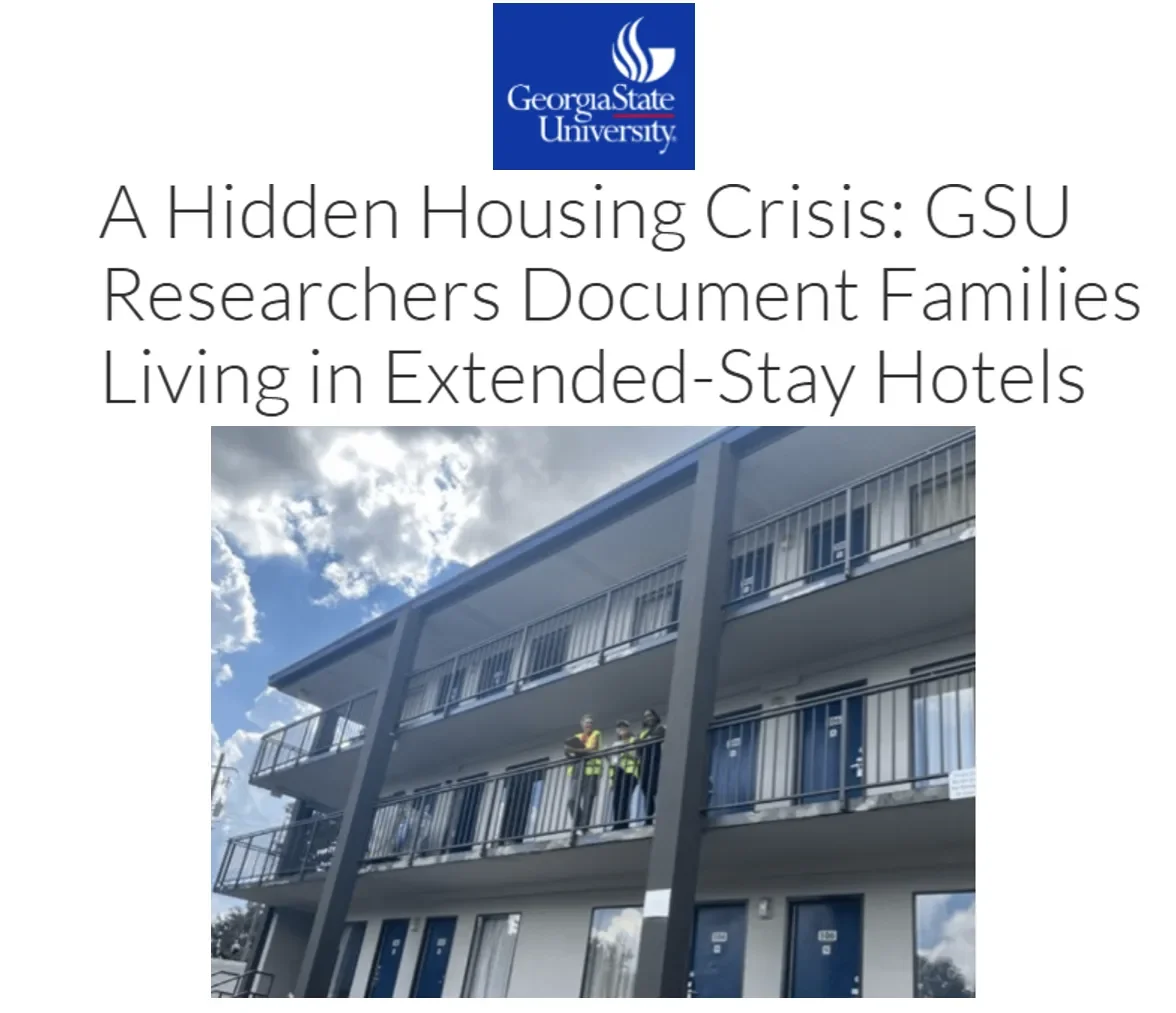
Georgia State University Research Families Living In Extended-Stay Hotels
One Community is Doing Something About It
Family homelessness is rampant and deeply damaging to the kids affected. But, as we wrote here a few months ago (Out of Sight, Out of Mind: Unhoused Families are Being Ignored”), unhoused families are often uncounted and unserved by programs designed to address the crisis that is visible in encampments and people living on urban streets.
Melissa and her kids are the hidden homeless. It sometimes seems no one cares about them.
Yet there are examples that provide hope. The latest is a brand-new program in DeKalb County in the Atlanta, Georgia metropolitan area.
In July, a unanimous vote by the DeKalb County Board of Commissioners approved $8 million for the community’s first-ever transitional housing program for low-income families. By Christmas, 60 families who had been living in extended-stay hotels moved into safe, spacious apartments with services that include case management and childcare resources.
“This project reflects our belief that housing is foundational,” DeKalb County CEO Lorraine Cochran-Johnson said. “When families have stability, children can thrive, parents can focus on work and wellness, and communities grow stronger.” The new program and the Georgia State University research that demonstrated its need were both led in part by Sue Sullivan, a longtime advocate for unhoused families.
Sullivan has been lifting up this crisis for a long time. “No one is talking about these families,” she told a reporter back in 2024.
They are now, at least in DeKalb County, Georgia. Even better, elected officials are taking tangible action to help families like Melissa’s.
That should be the case in every community across the country. Is it in yours?
