Why We Can’t Have Nice Things
Killing the Historically Successful Responses to Covid Poverty
This piece originally appeared on Fran Quigley’s blog Housing Is A Human Right on November 28, 2025.
This is part one in a three-part series exploring how the U.S. created and expanded amazing social programs in response to the early months of the Covid pandemic, only to backtrack fully despite all the success.
Part One covers how and why politicians have convinced us that Americans do not support programs for housing, food, and healthcare—even though history and current public opinion polling show convincingly that we do.
Part Two discusses the dramatic, historic impact that Covid response programs like expanded unemployment insurance and child tax credits had. Millions more people were safely housed and fed, and more had access to healthcare. Who could not love this?
Part Three answers that question: Corporations and wealthy individuals who are dependent on a population that is desperate enough to take on sub-poverty-wage jobs—a dynamic that has been in place for decades—killed off these programs.
Jacobin published my article covering portions of these themes, especially Parts Two and Three. You can read it on their site here.
There is an enduring perception that the United States is an individualistic nation whose people oppose collective guarantees to the basic necessities of life. This perception is false.
As proven by the overwhelming popularity of our Social Security program and the guarantees of free public education contained in every state constitution , the U.S. already has some well-established economic rights that are deeply woven into the fabric of our society.
A number of states and cities have adopted a version of a Homeless Bill of Rights or similar legal commitments to the right to housing. The right to clean water and air, sometimes known as “Green Amendments,” is recognized in the state constitutions or statutes of California, Massachusetts, Pennsylvania, Illinois, Hawaii, Montana, and in several municipal ordinances.
The American public is ready to make these rights nationwide and enforceable. Public opinion polls in recent years show strong majorities in support of recognizing and enforcing housing and healthcare as human rights and calling for the government to do more to address food insecurity. Most Americans have long supported a government jobs guarantee.
So, what is stopping us? Political elites who carry out the agendas of corporations and wealthy individuals.
Ronald Reagan justified his slashing of government aid programs by famously claiming, “The nine most terrifying words in the English language are: ‘I’m from the Government, and I’m here to help.”
Bill Clinton alleged a “cycle of dependence” when making devastating cuts to financial help for families with children. Donald Trump has complained of welfare that “people are taking advantage of the system.”
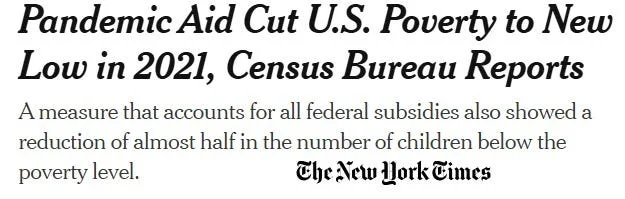
The data refute all of these claims. Government assistance is proven to be effective at helping many families move out of poverty, not remain mired in it.
A Workforce Desperate Enough to Take Sub-Poverty Wage Jobs
In fact, the effectiveness of these programs is the very reason that so many leading politicians oppose them. In the U.S., wealthy people and corporations enjoy outsize influence on the political system thanks to de facto unlimited ability to fund campaigns and lobby lawmakers. So they seek to preserve and expand the benefits of some of the lowest tax rates in the world.
But the wealthy’s main priority in opposing economic support programs is something else: their need to maintain a steady supply of people desperate enough to accept work at sub-poverty wages. The most recent, striking example was the undermining of the enormously successful economic programs created in response to the devastation of the Covid-19 pandemic.
Lest we forget, devastation is not too strong of a word. In March and April of 2020, the U.S. lost 22 million jobs. During the full year of 2020, more jobs were lost than at any time in the 80-plus years of recorded U.S. history—and more than the next two highest job-loss years combined.
The U.S. system connects healthcare to employment, so those job losses were accompanied by cut off access to healthcare, along with a rise in hunger. A wave of evictions and foreclosures was looming. For tens of millions of Americans, disaster was at their front door.
Yet, by 2021, not only was disaster averted, but the percentage of U.S. people and children living in poverty actually dropped to the lowest in recorded history. Evictions plummeted. Millions less children were hungry than before the pandemic.
This was no miracle. It was the U.S. government unleashing the power it always had—and still has today—to ensure that basic needs are met, and that no one in this country be homeless, go hungry, or endure without the healthcare they need.
In Part Two, we explore how the government unleased this power, quickly followed by wealthy and corporate forces strenuously objecting to so many Americans being healthy and safe.
