Safe Park Indy Relaunches Homelessness Parking Program
June 2, 2026
This piece originally posted on Parking Today
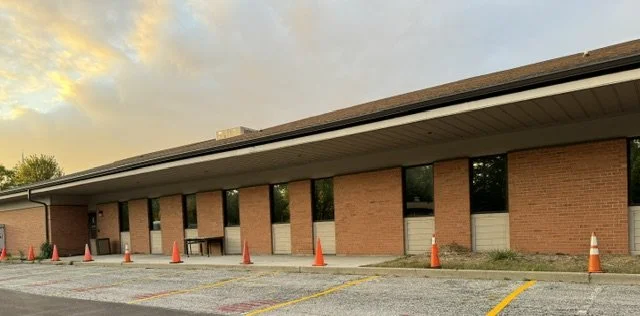
For its pilot program that began in 2024, Safe Parking Indy initially operated out of this church parking lot. Photo courtesy of Elizabeth Friedland.
By Larson McDonagh
On June 1, Safe Park Indy (SPI), Indianapolis’s vehicular homelessness parking program, resumed operations after a yearlong hiatus. Known as Safe Park Indy 2.0, the new, improved model is designed with flexibility and automation to better meet the community’s needs and reduce the program’s labor requirements.
Meeting a need
In 2024, the National Homelessness Law Center reported that “the number of unhoused persons on a single night across the United States (U.S.) reached 771,480—or about 23 of every 10,000 people—which is the highest ever recorded.” This represented an increase of more than 18% from 2023 to 2024.
Elizabeth Friedland saw the increase in vehicular homelessness in Indiana and the absence of safe overnight parking and knew something had to be done. Despite having no background in nonprofit management, Friedland founded Safe Park Indy. She was familiar with the issue through reading articles about established parking programs on the West Coast, such as New Beginnings Santa Barbara and Safe Park LA.
“It was so stupidly simple in the best way possible,” Friedland said. “If you’ve got empty parking lots, [and] you have people who are living in their cars, what a perfect solution.” With her background in corporate communications, she developed an operations plan based on those programs and adjusted the blueprint to fit Indiana’s unique needs.
The pilot
The pilot program ran for a year, from 2024 to 2025, in three locations. Friedland said the program was an experiment and was entirely run by volunteers who, like herself, had other jobs, limiting the time they could devote to it.
In the first year, SPI had no safety or crime incidents. Friedland said the initial pushback to the program came from neighbors worried about crime and drug use.
“We were really proud to be able to say nothing happened,” Friedland said. “These are just normal people like you and me trying to get a good night’s sleep.”
Jennifer Tijunin, a council member of a participating host church on the south side of Indianapolis, echoed this sentiment. “We had no incidents of anything, not even littering,” she said. “No crime. No problems at all.”
“After our first year, which was very successful, we paused largely because of bandwidth,” Friedland said. “I didn’t have the time to operate the program in the way that I felt it needed to be successful.”
The relaunch
With a waitlist of approximately 400 people during the pilot, Friedland wasn’t willing to let the program die. “So, we are back, starting June 1, with a re-engineered program that makes it much more sustainable for us in the long term,” Friedland said.
SPI 2.0 is operating at two parking lots hosted by faith-based organizations, though SPI is not a faith-based group. Tijunin said that Friedland was clear that the program was not for evangelical outreach. However, “it does fit very well with loving thy neighbor and helping those who are marginalized and oppressed,” Tijunin said.
“We will have two lots running at the same time,” Friedland said. “Before, we mostly ran one lot at a time with minimal overlap,” she said. The lots are also larger, helping meet the needs highlighted in the pilot program, which accommodated 10 to 20 people at a time. With more space, the program now can host 30 to 60 people.
Who benefits
While researching how to run a safe parking program, Friedland couldn’t find publicly available data regarding Indiana’s homeless population. Using the demographics of 475 program applicants, she created Indiana’s first comprehensive vehicular homelessness demographics dataset.
According to the dataset, 63% of program participants are experiencing homelessness for the first time. Among applicants, 41% have a college degree and 45% are employed.
The statistics SPI provides on its website have really helped humanize the people using this program, Tijunin said. She believes it helps deconstruct negative stereotypes and is an important part of getting the word out about programs like SPI.
The logistics
Safe Park Indy spends about $1,000 a month, per lot, running the program. These funds cover expenses related to portable toilet rentals, a sink with running water, and a supplies cabinet with food, hygiene, safety, and comfort supplies. SPI also supplies low-cost gym memberships so clients can access shower facilities. The organization provides liability insurance for host locations.
“These are pretty low-cost compared to other homelessness intervention methods,” Friedland said. Additional donations help to cover such items as gift cards for gas and restaurants.
Friedland intentionally avoided making Safe Park Indy an official non-profit organization due to the administrative work required. As a result, the grassroots organization misses out on government funding. However, Safe Park Indy receives support from local nonprofits like the Indy Hygiene Hub and Project Period. These organizations help supply hygiene products for SPI’s supply cabinets.
The remodel
SPI 2.0 is remodeled in several ways. The new waitlist is primed to reduce labor for both the volunteers and clients parking with SPI.
“Initially, we had a wait list, and it was first-come, first-served,” Friedland said. “When a spot opened up, we went to the next name on the wait list. We would give folks 24 hours to respond to us and claim the spot.”
However, this method was time-consuming and didn’t align with the reality of living in a vehicle. “Homelessness is very transient by nature,” Friedland said. “By the time we got to somebody on the wait list, and maybe they applied four months ago, they don’t need the spot anymore. But we were still having people apply that day.”
With the new format, when a spot opens, all waitlisted clients are contacted, and the first to respond gets the spot. Friedland said this approach will reduce labor needs because volunteers won’t need “to manually go down the list and reach out to every single person until we can contact somebody,” she explained.
“We also think it’s more reflective of the need,” Friedland said. “If you need the spot today, and you’re watching your phone closely because you’re really hoping the spot comes up and you’re able to respond right away, then you get that spot regardless of where you are on the wait list.”
The check-in process was also automated. Instead of staff checking the physical spots and requiring clients to be there, clients text a photo of themselves occupying their spot.
‘Easy way to give back’
The two original congregations that originally hosted SPI were a part of The Greater Indianapolis Multifaith Alliance, an advocacy organization focused on homelessness and evictions. Rabbi Aaron Spiegel, the organization’s executive director, was thrilled to see the relaunch of SPI.
“I hope it becomes a standard part of the homeless landscape in Indianapolis,” Spiegel said. “That said, I wish we didn’t need it.”
He said organizations like SPI and shelters are stopgap measures that don’t actually solve the root cause of homelessness. However, until the housing infrastructure changes to match the need, overnight lots are a great immediate solution.
“It’s really just such an easy way to give back,” Tijunin said. “Times are tough…there are so many people that are just one paycheck away from an inability to pay their rent or mortgage. It’s something you wish someone would do for you.”
Larson McDonagh is a freelance environmental journalist based in Shoreline, Washington. They can be reached at lars@parkingtoday.com.